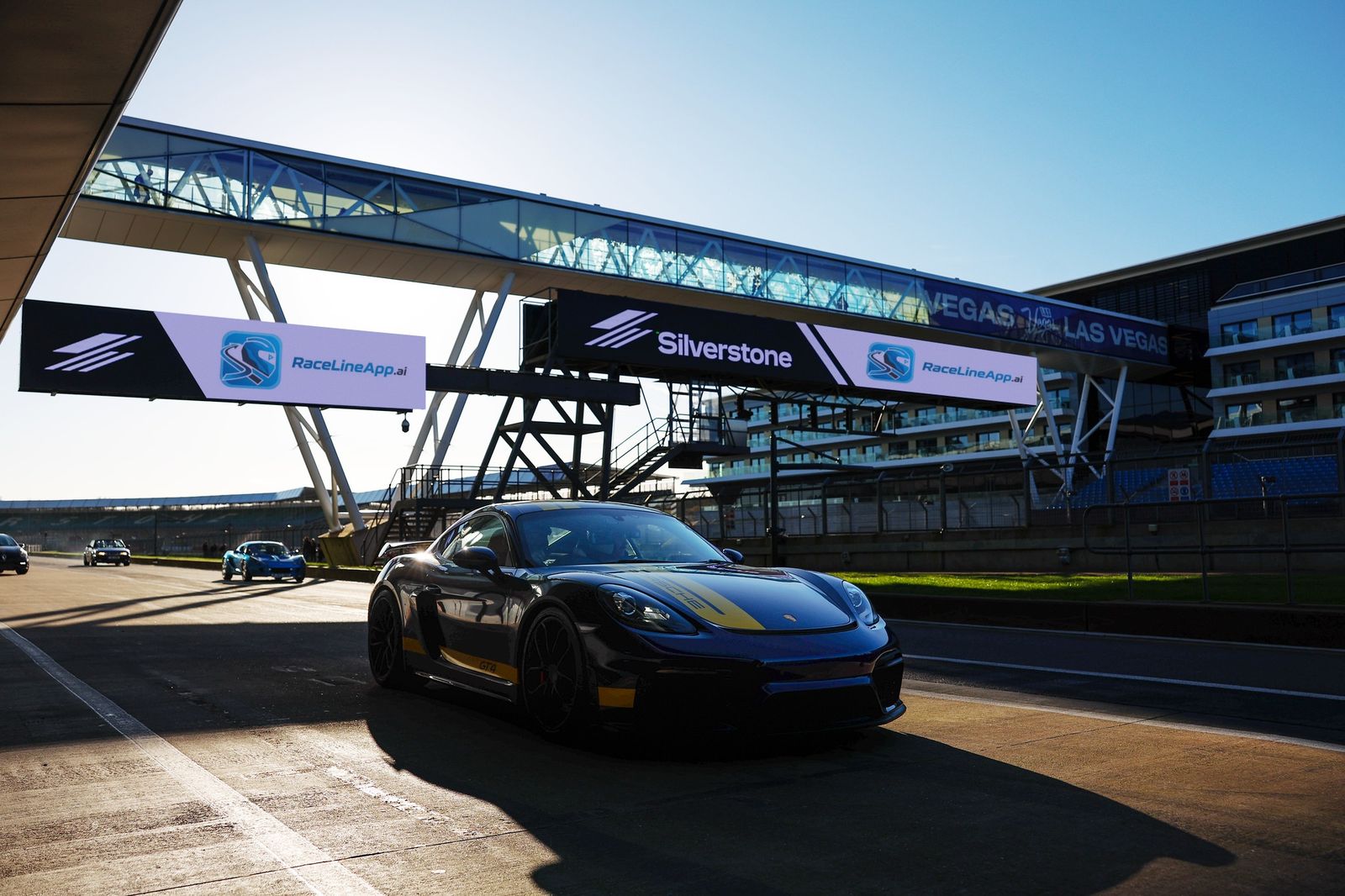
A successful test day for live AI coaching at Donington
Our test day at Donington Park on 19 October 2026 was a success. RaceLineApp.ai coached every lap live, everything we set out to prove held up, and the day went beyond what we'd hoped.
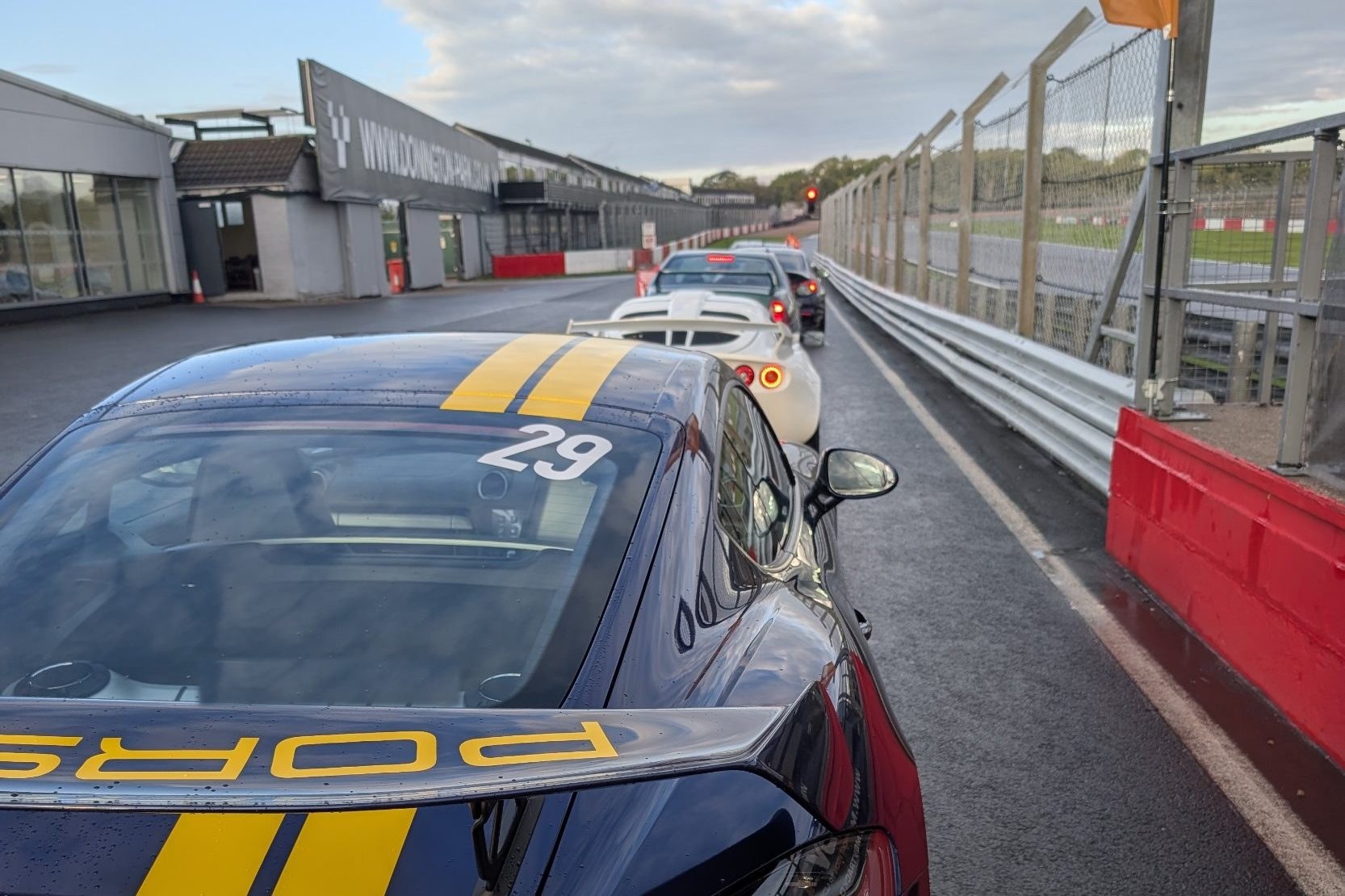
The day at a glance
- When
- Monday 19 October 2026
- Where
- Donington Park National circuit, Castle Donington, Leicestershire
- Car
- Porsche 718 Cayman GT4
- Conditions
- A wet morning, then dry from lunchtime
- What we tested
- RaceLineApp.ai coaching every lap live
- Result
- 15 coached sessions, 1,108 cues spoken in the car, and Jonathan 6.3 seconds faster in about an hour of dry running
On Monday 19 October we took RaceLineApp.ai to Donington Park for a full test day. The app coached every lap out loud and in real time. It ran on a standard phone with a GNSS puck in a Porsche 718 Cayman GT4. It coached through a wet morning and a dry afternoon, and it held up to everything we asked of it.
What was the test day for?
A week earlier, Mark wrote Jonathan a guide to the Donington National circuit and sent him off to drive it without him. This was that day.
The idea behind RaceLineApp is simple. Existing tools predict lap times and capture everything that happens on track. None of them can tell you what to do in the moment - by the time you analyse it, the lap is already gone. We tell the driver what to do while the lap is still happening.
So the question for the day was a big one. Can a phone coach a driver live, on a real circuit?
Who was at Donington?
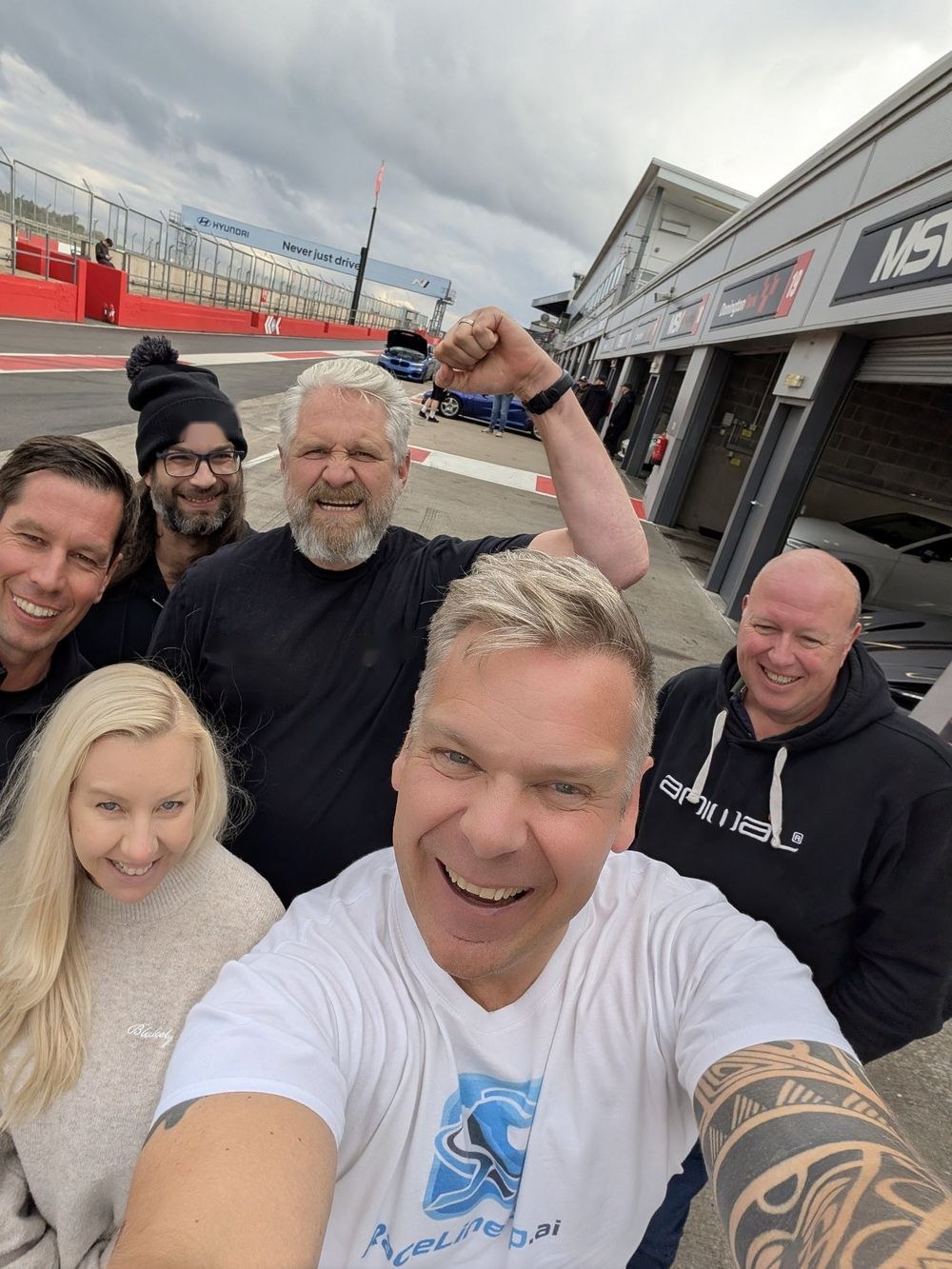
Jonathan drove the GT4. He wasn’t on his own for long. Jim Cameron turned up out of the blue that morning as a surprise, and Jack came up with him. Jim is a racer and an instructor, and he advises RaceLineApp.
Wayne came in his McLaren 720S with his wife Jo. Paul brought his Jaguar F-Type V8.
Mark wasn’t there. He was at Anglesey having fun drifting his M2. He was with us in spirit, though, and his voice called the cues in the car all day.
What did we set out to prove?
The day had to show four things. All four held up.
The hardware holds up
The phone and the GNSS puck tracked the car precisely all day, in the wet and in the dry.
The cues reach the driver
1,108 cues were spoken in the car, through the car's speakers and through smart glasses.
The app stays safe
No cues in the pit lane or on the way out of it. One tap silences everything.
It learns the driver
Every session taught the app more about how Jonathan brakes, and later sessions coached from his own braking.
The day in numbers
Every lap was recorded and synced to video, so every update we make can be checked against what really happened on track.
How did the day go, from wet to dry?
- MorningA wet track
The first sessions ran on a wet circuit, with the app coaching from the very first lap. The Cup tyres on the GT4 don't love the wet, so we kept the car tidy and learned a lot.
- Between sessionsBuilt in the paddock
We reviewed the data between sessions, changed the app and reinstalled it on the phone, then went straight back out. Four updates shipped at the circuit. Jonathan asked for gentler language on a damp track, and it was in the car before lunch. Damp and wet sessions started learning together. We placed "Roll in" where Jonathan actually starts to turn. We tried a "Full lock" cue on track and took it out again.
Squeeze on the powerRoll inFull lockJonathan in the pit lane while the app was rebuilt between sessions. - LunchtimeDrying out
As the track dried we switched the app to dry conditions, and Jim climbed into the passenger seat to coach alongside it. Then it was time to open up.
- AfternoonDry and quick
Jonathan went 6.3 seconds faster in about an hour of dry running. Jim took the wheel himself, and in four sessions the calls played through smart glasses instead of the car's speakers.
The GT4 on the straight in the afternoon. - Drive homeAlpha passed
We left Donington with a wealth of data and a long list of ideas for the next build.
What does live coaching sound like on track?
This is one continuous take from the afternoon, from the approach to Redgate, down the Craner Curves and through the Old Hairpin to the exit of McLeans. Turn the sound on. You’ll hear the calls through the car’s speakers as Jonathan drives: Brake, Turn in, Power. The in-car screen is in the corner of the picture.
What happened when an experienced driver took it to the edge?
Jim spent part of the day in the passenger seat, coaching Jonathan alongside the app. His coaching and the app’s data agreed on where the time was. At the Old Hairpin it was all about getting on the power earlier. Jim’s phrasing for each corner was recorded too, and we’ll put it to Mark as ideas for the cue library.
In the afternoon Jim took the wheel himself with the app set to Finding the limit, our top coaching level. We wanted an experienced driver to push it as close to the limit as the car allows. He did exactly that. Jim carried far more speed through the middle of the corners, with about 68 mph at the slowest point of the Old Hairpin, and used close to everything the car had. That gave us our first real data at the edge of the car’s grip, which is where our most experienced drivers will be coached.
Where did the 6.3 seconds come from?
The app breaks every lap down corner by corner. Here’s Jonathan’s first dry lap against his best one, about an hour later, in the same debrief the app shows after a session. Every corner gained time, and Redgate gave the most.
Slowest point 49 to 54 mph. Exit 67 to 76 mph.
Slowest point 48 mph on both laps. Exit 69 to 71 mph.
Slowest point 50 to 54 mph. Exit 67 to 72 mph.
- McLeans0.5 s
- Craner Curves0.5 s
- Schwantz0.4 s
- Old Hairpin0.3 s
- Hollywood0.1 s
- Rest of the lap0.2 s
Faster through every corner on the best lap.
Braking more consistent at four of the five main braking zones.
What did we learn?
The braking got more consistent. From his first dry sessions to his last, Jonathan’s braking point moved around less from lap to lap at four of the five main braking zones. At Redgate the spread tightened from 39 m to 24 m.
The app learned the driver. Every session fed a saved profile with Jonathan’s real braking from the day. Later sessions timed their cues from that profile rather than from a generic model. That’s the start of coaching that fits the driver in the car.
Smart glasses work brilliantly. In four afternoon sessions the calls played through smart glasses instead of the car’s speakers. The sound sat right at Jonathan’s ear, clear over the engine, with no need to turn the car’s volume up.
The driver shapes the coaching. On a greasy track Jonathan asked for gentler language, and “Squeeze on the power” was in the car before lunch. Being able to change the coaching between sessions, and drive it again straight away, was one of the most valuable things about the day.
Did it meet our expectations?
It went far beyond them. Asked to score the day out of five, Jonathan gave it ten.
That was a successful test day. We've captured an absolute wealth of data. We're already starting to see the app and the AI modelling it, changing the cues and making the movement better. Phenomenal day. Alpha passed.
What’s next?
We have more testing and more track days ahead. Our next stop is Anglesey for the Race of Remembrance. After that we’re back at Donington towards the end of November. We’ll be testing, refining and improving right through the winter.
We’d like to say a huge thank you to Jim, Jack, Wayne, Jo and Paul for coming along and supporting us.
Quick answers
What is RaceLineApp.ai?
RaceLineApp.ai is live AI coaching for track day drivers. It tells you what to do in the moment, during the lap, with short spoken cues such as Brake, Turn in and Power, and nothing to read at speed. It is the world's first real-time AI race engineer.
Where and when did RaceLineApp.ai test at Donington Park?
We ran a full test day on the Donington Park National circuit, Castle Donington, Leicestershire, on Monday 19 October 2026. The app coached 15 sessions live in a Porsche 718 Cayman GT4, from a wet morning to a dry afternoon.
Does RaceLineApp.ai work in the wet?
Yes. You tell the app the conditions before each session, and the cues change to suit them. On a damp or wet track it uses softer cues, such as Squeeze on the power. At Donington it coached through a wet morning before the track dried.
How do you hear the coaching?
You hear it through a Bluetooth earpiece or your helmet comms. At Donington we also played the calls through the car's speakers, and in four afternoon sessions through smart glasses, with the sound right at the driver's ear.
Is RaceLineApp.ai a lap timer?
No. RaceLineApp.ai records your laps, but it is not a lap timer. Its job is to coach you live, corner by corner, while the lap is still happening.
Is it safe to be coached live on track?
The cues are advisory and the driver stays in charge. The app gives no cues in the pit lane, one tap silences everything, and it is for use on closed racing circuits only.
How can I try RaceLineApp.ai?
We're testing on track right through the winter. The next step is a closed beta day at Silverstone GP in spring 2027, where we test at scale with 50 drivers. You can register your interest on the beta page.